Reviews:
Merging - Milan Svoboda piano solo
(CD Radioservis 2004 - CRO 287-2-531)
A piano solo concert is always a very hard challenge for any jazz player.
What does the audience expect from it? The artist's popular repertoire? Listening
to standard themes? Or maybe what is expected is something completely different
and new, something never heard before?
Actually the piano solo recital has its own history in jazz, a necessary
inference that anyone stepping on stage has to deal with while curtain is
opening; a floating history where many circumstances, trends and events flow
into. I think that we all do agree saying that Keith Jarrett has a particular
place in this history, considering that he did draw two main directions in
executing piano solo concertos: the first drawn by his unforgettable performance
in Cologne, the other one by the work titled "Facing you" (recently reprised
in his last work "Radiance"). What he did in Koln is unique: total and free
improvisation starting from embryonic musical cells and sailing across a
wide open sea comparable to the troubled waters of the "stream of consciousness".
His defiance consists in developing these cells until their extreme consequences,
until an ideal and triumphant "deadline". From magma to matter, we could
say. On the other hand "Facing you" celebrates the primary role of the song:
an existing and developed theme is taken in order to be reprised, de-mounted
and mounted up again, or to be just suggested and evocated by instantaneous
hints. From matter to magma. The most evident difference between these two
opposite ways of approaching solo recitals lays on the last of the tracks:
in the Koln concert every track needs 20-30 minutes to be developed and come
to conclusion. In "Facing you" this requirement is not needed, on the contrary
it's almost rejected.
In his solo recital Milan Svoboda seems to follow this second way (the "Facing
you" way): in fact he proposes a program of his own compositions, themes
and songs that he faces with an uncommon mastery of the instrument and alternating
between moments of "theme introduction" and moments of pure improvisation.
But what I find extraordinary about this programmatic purpose is that in
the overture (Spring Song) and in the middle of his perfomance, while
playing the beautiful aria of Prolínání-Variace as introduction
of the variations suite, he clearly cites Jarrett, or better the "Koln-Jarrett".
This contradiction is outward. The truth is that Milan Svoboda's wealth of
experiences and knowledge always leaves place to his talented originality.
Is this whole piano recital a tribute to Jarrett? Of course it's not. Actually
the range of evocated influences is impressive: from Jarrett to Bley passing
through Oscar Peterson (not mentioned if we're considering the repertoire,
but evocated in my opinion by the pure joy in playing piano without intellectual
excesses); but even classical echoes can be recognized, especially of our
contemporary music: Bartok, Stravinsky, Schrjabin.
His own compositions (which structure is "modal") and his will of freedom
in improvising on them are "merged" in a very original way. The real little
miracle of Svoboda's performance consists in remaining Milan Svoboda himself
during his "merging" operation. And that's possible because of his and education:
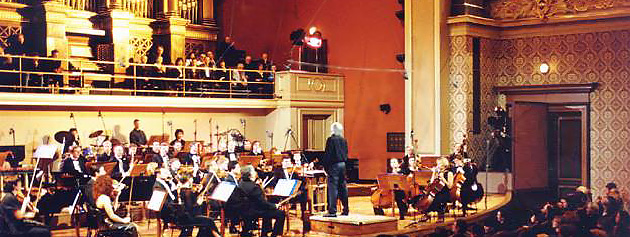
Milan Svoboda, born in Prague in 1951, is a composer, a conductor, a big
band leader: a critical side of his soul that leaves a deep mark over the
Rudolfinum performance. His ability in alternating and balancing different
figures, from ostinato to adagios movements, from crescendo to diminuendo
rhythmic figures can be only considered as the ability of someone who is
used to conduct, arrange and lead a band, keeping always in mind the different
scores of each component. Furthermore what is really exciting of this album
is Milan Svoboda's technique: his sensitivity of touching is incredible and
allows him to change register in a natural and effective way. And exactly
these jumps from a register to another without losing sight of the sense
of each composition are what I appreciated most.
~ Giorgio Bianchi
http://www.jazzport.cz/index.php?option=com_content&task=view&id=319&Itemid=50